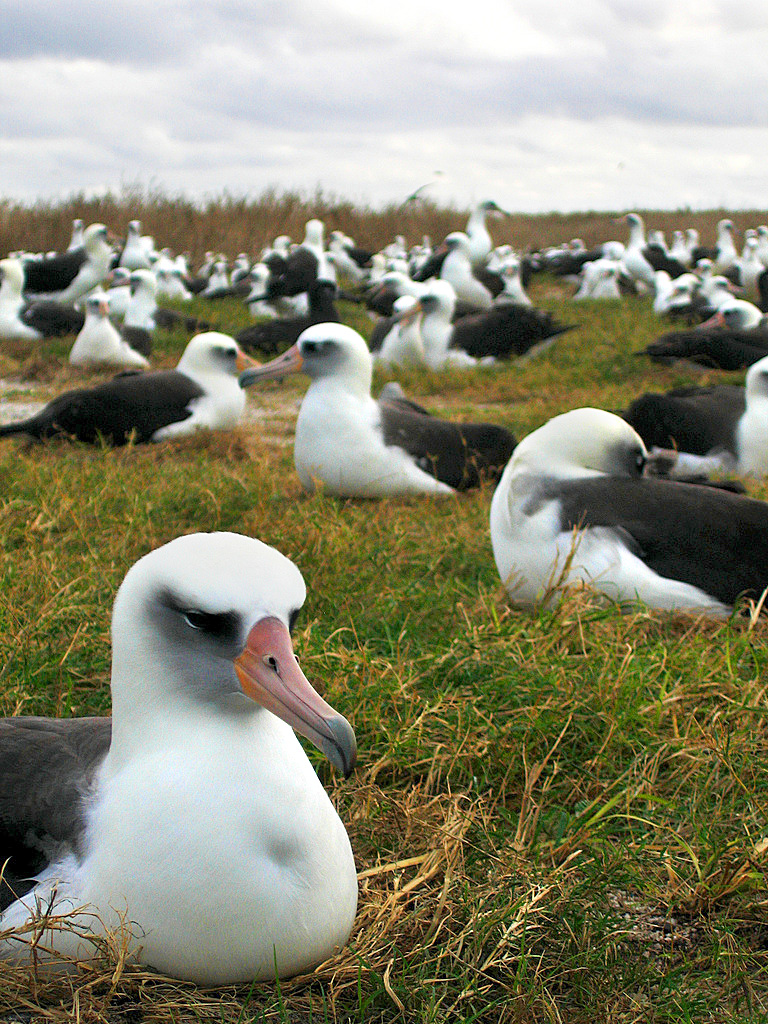
The Malvinas Islands (Falklands) host a unique ecosystem shaped by their cold, windy climate and isolation. The fauna is dominated by marine mammals and seabirds, while the flora consists mainly of grasses, shrubs, and peat bog vegetation, with no native trees.

Flora of the Malvinas Islands

  • Grasslands and Shrubs: The islands are largely covered by tussac grass (Festuca flabellata), which can grow up to 2 meters tall and provides shelter for birds and sea lions.

  • Peat Bogs: Extensive peatlands support mosses and small herbaceous plants.

  • Heathlands: Areas with dwarf shrubs and hardy plants adapted to poor soils and strong winds.

  • Endemic Plants: Species such as Malvinas Daisy (Perezia recurvata) and Malvinas Violet (Viola maculata) are unique to the islands.

  • Absence of Native Trees: No native arboreal vegetation exists today, though fossil records show ancient cypress and araucaria forests.

Fauna of the Malvinas Islands

Marine Mammals
  • Seals and Sea Lions: Southern sea lions, elephant seals, and fur seals are common along the coasts.

  • Cetaceans: Orcas, dolphins, and several whale species migrate through surrounding waters.

Birds
  • Penguins: Five species breed here: King, Gentoo, Rockhopper, Macaroni, and Magellanic penguins.

  • Seabirds: Albatrosses, petrels, cormorants, and skuas thrive in the nutrient-rich waters.

  • Land Birds: The Falkland steamer duck (flightless), upland goose, and the endemic Cobb’s wren are notable.

Invertebrates
  • Endemic Beetles: Several species of ground beetles and weevils are unique to the islands, such as Malvinius compressiventris.

Conservation Notes

  • Fragile Ecosystem: The harsh climate limits biodiversity, making species highly specialized and vulnerable.

  • Threats: Introduced species (rats, cats) have impacted native bird populations.

  • Protection Efforts: Conservation programs focus on seabird colonies and restoring tussac grass habitats.

Quick Comparison Table

Category
Key Species/Features
Notes

Flora
Tussac grass, peat bog mosses, endemic daisies
No native trees; vegetation adapted to wind/cold

Marine Mammals
Sea lions, elephant seals, dolphins, whales
Coastal and migratory presence

Birds
Penguins (5 species), albatrosses, Cobb’s wren
Major global seabird colonies

Invertebrates
Endemic beetles, weevils
High endemism despite low diversity

In short: the Malvinas Islands are a haven for seabirds and marine mammals, with vegetation dominated by tussac grass and peat bogs. Their isolation has fostered unique endemic species, but conservation is crucial to protect this fragile ecosystem.

As we headed further and further north on the map, my excitement grew. The whole area was already starting to be uncharted territory for me, so I was very curious to see what things were like in that part of my country. We were already very close to achieving our improvised goal of reaching Bolivia, but along the way we were also seeing some very curious places. One obligatory stop was La Quiaca, the northernmost city in Argentina in the province of Jujuy, where we took two nights to rest and also to sort out our paperwork before crossing the border .


$1


After driving more than 180 km in the small Suzuki 4x4, we left Iruya in the province of Salta to head to La Quiaca, in the province of Jujuy. That would be our last stop in Argentina before heading to the neighboring country. It was impossible to go any further, because we were literally about to cross to the other side. However, despite being so close, we needed some time to be able to go to the ATM to withdraw cash so we could get a good exchange rate in Bolivia, try to get the yellow fever vaccine and be able to fill up with gas before crossing. For this we stayed two nights in a small hostel for which we paid $25 per night for two people


$1 $1 $1 $1


As for money, we were able to get a good amount from ATMs and this was the most convenient thing, since due to the high taxes Argentina imposes on using debit and credit cards abroad, the best option was to pay for everything with cash. Regarding the yellow fever vaccine, we had read that it was necessary but I went to the hospital and couldn't get it because it wasn't the day they were doing the vaccination campaign. I risked going to Bolivia anyway, hoping not to get sick from anything (spoiler: I didn't get sick from anything). Third, we were able to fill a jerry can with extra gasoline, which was what we wanted, since we were afraid of not getting it easily in Bolivia, since there was a rumor that they didn't sell it to foreigners .


$1 $1 $1


All of these things took up the time we decided to stay in La Quiaca. As for the city, like any border city, it is not as touristy or elegant, but it is still full of signs that highlight what distinguishes it: being the northernmost city in Argentina. There are signs everywhere for photos, and many stickers of people who wanted to leave their mark on this place. In addition, everything was quite cheap here, just like what we saw in our previous days in other northern cities .


$1 $1 $1 $1


The city of La Quiaca in Jujuy represents the northern end of the famous journey that crosses my country from end to end along Route 40, parallel to the Andes Mountains and ending in the city of Ushuaia, Tierra del Fuego province. This route covers 5,194 km and visits 11 of the 23 provinces we have in Argentina. This trip is one of the most desired by nomadic travelers, who choose to do it in different vehicles, from cars, trucks, motorcycles and motorhomes to bicycles. Being at either end of this route, whether in La Quiaca or Ushuaia, is exciting, and that is how I felt after finally getting to know this city, because I already knew Ushuaia .


$1 $1


$1
$1


$1 $1


I think that throughout this whole traveling phase of my life, which began almost a year and a half ago, I did a lot of great things and being in the northernmost and southernmost extremes of my country was one of them. When I decided that I wanted to travel a bit around the north of Argentina, I didn't think that I would literally get to La Quiaca, the furthest north we have. I really enjoyed getting to know this place, which despite being simple has a very special value for travelers and for all of us who love Argentina and love Route 40. Once again, I was able to get to know a new corner of the many we have here .


❤️ Hope you liked this post! Thanks for reading. ❤️


$1

source

If your idea of having a good day is to go relax or do activities in the mountains of San Juan, going to the Zonda ravine is one of the most recommended options. These dry, orange mountains have options of all types and difficulties, from demanding trekking to a camping base with a pool to cool off a little. If you ask me, what I like most is to be on the move, so as soon as I could, I dedicated myself to exploring which trails I could walk on and that's how I found the one that in my opinion was the easiest of all: the one that led to the famous "Indian's Head" .


Pinmapple (18x12) (13).png


The Zonda ravine is a mountainous landscape that extends for about four kilometers, so you can easily reach one of its ends, next to which a greenish valley extends. Many people come to this place with the idea of seeing the beginning of the mountain range and there you can find a small trekking with an ascent to have more beautiful views of the entire area. The good thing is that this trail is prepared for tourists and even has stairs for easier access ❤️.IMG_20230919_161222553~2.jpg IMG_20230919_161225840.jpg IMG_20230919_161219470~3.jpg IMG_20230919_163009774.jpg


Despite the stairs and the shortness of this path, you still had to take your time so as not to lose your breath. As we climbed, the sunlit mountains decorated our landscape. I also liked that it is an easy and well-prepared trail so that many visitors can reach it ❤️.IMG_20230919_164204381.jpg IMG_20230919_164156612.jpg IMG_20230919_163857330.jpg


When we first started the climb, we saw a sign indicating that this trail was called "Seven Paths", but we didn't understand why until we were a little higher. Apparently, this path was originally some kind of level paths that went through some caves from one side to the other. Unfortunately, these trails had non-allowable signs, forcing you to climb the stairs until you reach the top .

IMG_20230919_163619121.jpg IMG_20230919_163253864.jpg IMG_20230919_164330367.jpg IMG_20230919_163531900.jpg


At the end of this route you could find a large white cross, a paved beach and a beautiful view of the Zonda valley. Everything was very photographable from up there and most people just stayed here enjoying the landscape. But we were not one of those and since we still had a lot of energy, we walked a little more .

IMG_20230919_163826716.jpg IMG_20230919_163817432~2.jpg


If you like to walk a little further, you can continue the path to your right along a fairly easy path but which may take a little time. The sign indicated that almost in the middle of the ravine was the Cabeza del Indio monument, so we went there .

IMG_20230919_164825645.jpg IMG_20230919_164833744.jpg IMG_20230919_165249992.jpg IMG_20230919_164637897.jpg


The reality is that the whole hard part was just climbing the stairs up there, because the rest of the way was mostly flat. As we went along the ravine, we could see more and more caves appearing in the landscape. These caves were like small anthills in the immensity of the mountain, and each one was on a different path .

IMG_20230919_164536459.jpg IMG_20230919_165557916.jpg IMG_20230919_165550146~2.jpg IMG_20230919_165552926.jpg


From there I could deduce that surely each of the seven paths that we had seen at the beginning would correspond to a different level of path with caves. As we climbed to the top of everything, we were traveling along the upper path. In reality, this was the only one that was apparently enabled, safe due to the constant risk of collapse in this area with constant seismic activity .

IMG_20230919_164353853.jpg IMG_20230919_165150111.jpg IMG_20230919_165801933.jpg IMG_20230919_165143313.jpg IMG_20230919_165137947.jpg


After a little more than 45 minutes of walking looking at the route below us, we began to approach what would be the famous monument. Something funny that happened to us is that on the billboard at the beginning there was no photo of the monument, so we expected to see a mountain shaped like an Indian. We clearly realized that this was not the case when we saw a white block appear in the middle of the orange landscape .

IMG_20230919_170220548.jpg IMG_20230919_170458496.jpg


I must say that that day I did not find the shape of an Indian head on the monument, but in my subsequent visits to the Zonda ravine and seeing the monument from another angle, I knew that I did not take the photos correctly. So at that moment I thought "what imagination do you have to have to see the shape", but at least I was satisfied with the views from up there .

IMG_20230919_170818777.jpg IMG_20230919_170911668.jpg IMG_20230919_170930542.jpg IMG_20230919_165931609.jpg


We thought we would get to the monument and that would be it, but to our surprise the path continued and continued. We, curious as always, continued until we were able to find a viewpoint with a good view of the abandoned racetrack. This racetrack has not been used for several years due to various accidents that occurred there, in addition to the fact that another larger and better racetrack was built in the province of San Juan. For now, only its nostalgic memory remains adorning the landscape .

IMG_20230919_171246295~2.jpg IMG_20230919_170501518.jpg IMG_20230919_171044762.jpg IMG_20230919_171753473.jpg


Of course we continued and continued walking, but little by little we realized that the path did not seem to go down the mountain at any time. We had two options: retrace our steps to civilly descend the stairs, or descend "wildly" along an improvised path. I will leave it to your discretion which option my friends and I chose, considering that the sun was already setting and that it was very close to our return bus arriving .

IMG_20230919_170716989.jpg IMG_20230919_173452696.jpg IMG_20230919_170642317.jpg


I really liked having arrived in the province of San Juan and discovering in-situ all the things it has to do. I feel that this province does not have as much tourist promotion as others, but that it deserves it because it is beautiful. If you like trekking and hiking, here you can find endless routes of which you could never get bored. It was great to have spent our day there and with each place we visited, we fell more and more in love with this ravine ❤️.

IMG_20230919_164140689.jpg

source

 
Copyright © 2015 Argentina Photo Gallery
Distributed By Gooyaabi Templates
-->