F

213.-Infografica-Ruta-de-los-7-Lagos.png

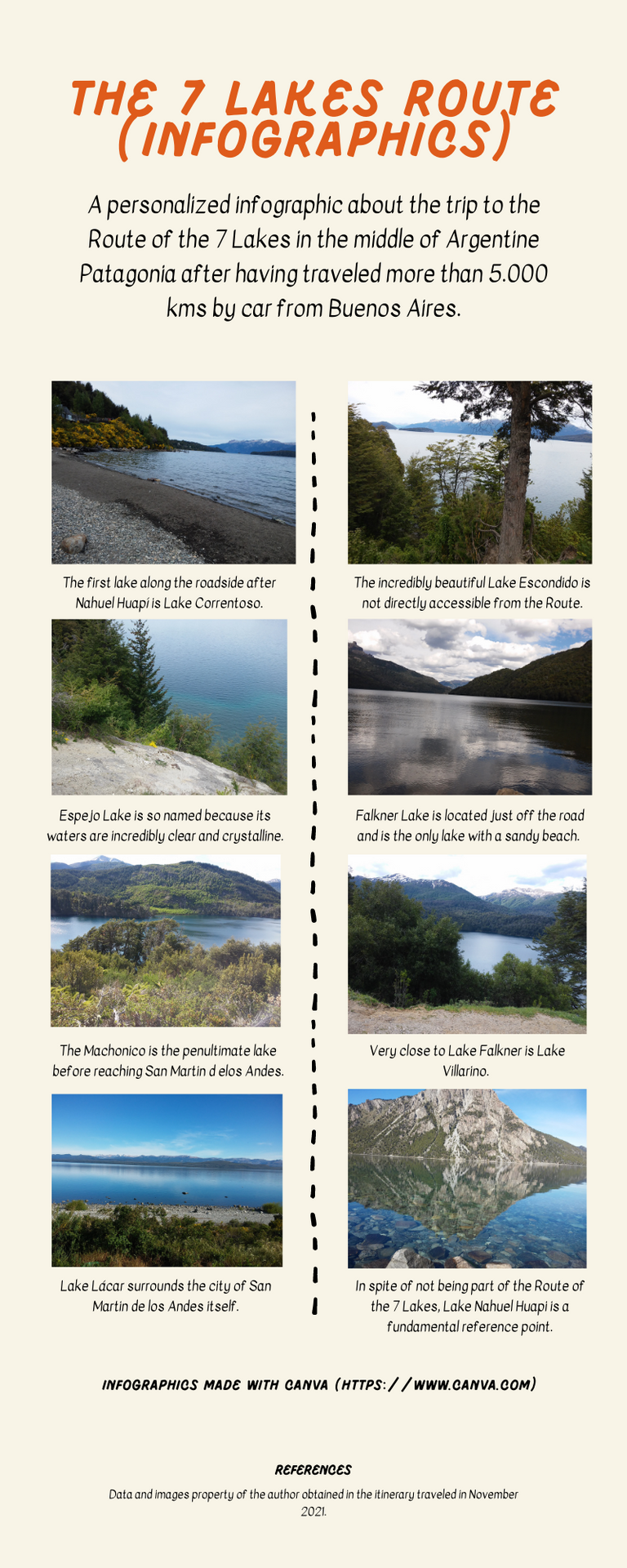
This infographic has been created to give a panoramic idea of what it means to visit the so-called Route of the 7 Lakes.

It is very difficult for those who visit this region of Argentine Patagonia to resist the temptation of traveling the Route of the 7 Lakes, famous all over the world for the wonder of its landscapes.

A splendor of nature that makes us stop the car not seven but countless times to admire a landscape so dazzling and of such a touching virginity, where there are no tourist resorts (in fact to rest you have to do it generally in Villa La Angostura or San Martin de los Andes) both end points of the route distant 110 kms from each other.

In the lakes there are camping and camping areas in general, but there are no hotels or establishments where to stay, so as not to alter with construction and mass tourism, the charm and naturalness of the region.

Some decades ago this stretch of road was not yet asphalted and for that reason it was called Camino de los 7 Lagos, today it is perfectly signposted and asphalted and it is a natural area protected by law, frequented by tourists from all over the landscape.

Normally the route is traveled in the direction San Martin de los Andes-Villa La Angostura because the panoramic viewpoints are on the edge of the road on the right side coming from that direction and are more comfortable for those traveling in the car.

We (my wife, Zeze the little pet toy and the writer) visited each Lake doing the opposite itinerary and for that reason many times we were forced to cross the road, with our eyes wide open because there are very close curves surrounded by mountains that obstruct the view of the road.

A simply wonderful trip and recommended to all those who love nature.

See you next time!
222.-Infografica-Sendero-de-las-Sombras-Lago-Puelo.jpg 

144.-20211029_110149.jpg

We have traveled more than 5,000 kms since we left Buenos Aires on our way to Patagonia and we have crossed itineraries already planned and others that have emerged as Gol devoured the kilometers in the immense Patagonian steppe.

One of the alternative routes selected is the so-called Route of the Araucarias because of the large number of these trees that we found along and across a vast expanse of territory in southern Argentina.

144.-20211029_110828.jpg

Throughout the province of Neuquén, at the foothills of the Andes Mountains, araucarias grow naturally in the squares of the mountain towns and villages, along the side of the roads, often unpaved, and of course in Andean forests and mountain slopes, serving as a frame for lakes of incredible beauty.

Arriving at Copahue in the north of the province of Neuquén and up to San Martín de los Andes, we find an ancient araucaria forest, fossilized after the passage of millions of years, perhaps the only one on the planet, in the middle of a forest vegetation of unearthly beauty.

144.-20211029_105628.jpg

To get to know and admire the beauty of this tour in its fullness, it is necessary to go through a triangle-shaped circuit, which includes the cities of Neuquén, Zapala and San Martín de los Andes.

In this part of the Andean-Patagonian forest, the araucaria is almost always associated with other native species of the region, such as the oak, the caña colihue, the coihue, the ñire and other endemic species.

144.-20211029_154203.jpg

In the town of Primeros Pinos (whose snow-covered mountains are ideal for skiing) the asphalt ends and the gravel road continues, a typical mountain road, winding with precipices, which requires driving with the utmost caution.

We continue straight ahead as if we wanted to enter the mountain range itself until Villa Pehuenia and the road begins to descend, 100 km downhill and through my centenary Sainuco and Kilca.

144.-20211030_104540_HDR.jpg

The spectacle of the journey has just begun!

Source

In a future post I will comment on my impressions lived when visiting the impressive Iguazú National Park within which are the famous Falls considered one of the 7 Wonders of the World, located on the border between Argentina and Brazil, as Travel Memories.

I am grouping this collection of Travel Memories delving into the depths of my memory, to try to take out of each trip the most salient, most curious, most impressive aspects.
I stayed for several days and had the opportunity to see several specimens of the native fauna and flora of that region up close.

The Blue Dancer a true treasure hidden in the missionary jungle.


I stayed for several days and had the opportunity to see several specimens of the native fauna and flora of that region up close.

And, specifically regarding fauna, I was struck by the dazzling colors of many birds.

Today I am going to refer to one of them that I had the possibility of photographing, however it is quite difficult to do so because it is not seen closely. Its habitat is the deep interior of the missionary jungle.
It is the Blue Dancer, a bird of very beautiful colors and that receives this name for the bridal dance that he practices when trying to conquer his partner.

The Blue Dancer hides deep in the missionary jungle.


It is a true treasure hidden in the missionary jungle. Her bridal dance is of extraordinary beauty.
Read also: Travel Memories #1: the amazing and varied fauna and flora in the Iguazu Falls.
As in many species of tropical and subtropical birds, the most striking colors are worn by the male.

The female has much more modest colors.

The male has a very striking coloration, with a light blue body and a bright red hood, in contrast to black wings.
The female has a much more modest plumage, being entirely olive green, lighter in the ventral area. Juvenile males are also green, albeit with the small red cap.

The Blue Dancer has long been proposed as a provincial bird of Misiones. Its approval is still pending.

The beginning of the bridal dance.

The Blue Dancers announce, with their singing, the beginning of the love procession.
Other pretenders join at once.
There is a very particular dance fashion to attract your partner.
The female will incline her preferences towards the best dancer.
The males begin the dance displaying the best of their technique.
A juvenile male observes the choreography to see how it is done.
For generations they dance on the same branch.
The dance continues uninterrupted.
Finally the female appears, the true reason for so much histrionic unfolding.
But nevertheless all the "artistic" demonstrations remain indifferent. Obviously he is not interested in either of the two adult candidates.
You will have to keep testing.
The disappointment of one of the candidates.
 
Copyright © 2015 Argentina Photo Gallery
Distributed By Gooyaabi Templates
-->