F
Showing posts with label Culture. Show all posts

Good morning friends ! Today I want to tell you about the day a friend took me on a tour, it was a surprise for me even though he had already told me a lot about this place. It's great to go out and meet a place that has been recommended to you!

Buen día amigos ! Hoy les quiero contar el día que un amigo me llevó de paseo, fue una sorpresa para mí aunque ya me había contado mucho sobre este lugar. Es grandioso salir a conocer un lugar que te han recomendado!

Colon Fabrica (1).png

It was Sunday and I was quite bored, my friend had already mentioned this place several times, and it seemed to him that I was going to love it. Everything he told me sounded interesting to me, but as I am also a little unbelieving, I just had to go and see.

Colon Fabrica (2).png

So we set out on our journey. We left my house and crossed a large part of the capital, heading for San Telmo, La Boca, Barracas, towards the waterfront that divides the south of the capital.

Así emprendimos el viaje. Salimos de mi casa y atravesamos gran parte de la capital, rumbo a San Telmo, La boca, Barracas, rumbo a la costanera que divide el sur de la capital.

Colon Fabrica (3).png

As soon as we arrived we had problems paying the entrance fee, as they did not accept cash and we did not have a specific card that they asked for. We solved it with a basic debit card and went in.

Colon Fabrica (19).png
Colon Fabrica (20).png
Colon Fabrica (22).png

The girl at the reception explains to us how is the tour selected by the foundation. She tells us that here they keep all the curtains and some assembled installations. All this cannot be touched. But to my surprise, the costumes on display can be touched !


We go in, I am still stunned by the locker room information. I immediately see Hamlet and decide to touch and move his cape. All the way through I'm dazed thinking about what it must be like to perform with these clothes and props on.

Entramos, yo sigo anonadada por el dato de los vestuarios. En seguida veo a Hamlet y decido tocar y mover su capa. Todo el recorrido me obnubilo pensando en lo que debe ser actuar con esta ropa y utilería encima.

Colon Fabrica (18).png

Colon Fabrica (26).png
Colon Fabrica (27).png
Colon Fabrica (30).png

The most exposed parts have a screen in front of them where you can see some scenes of the original work and both performances and furniture in mobility. You can see traffic circles turning, actors climbing stairs, etc.

Colon Fabrica (8).png

Colon Fabrica (7).png

The world of costumes has always had something striking for me, because of my acting background or because of the number of years I spent in school doing this kind of work, designs and colors. I see the colors and combinations in fabric designs, contrasts, types of fabrics, in short. Everything is delightful in this place. Sometimes I get nostalgic and want to go back to something as pleasurable and artistic as acting, wearing other clothes, and telling someone else's story.

Colon Fabrica (33).png
Colon Fabrica (34).png

Colon Fabrica (25).png
Colon Fabrica (24).png
Colon Fabrica (23).png

The more we walk and the more childlike I become. I try on war hats, sit on big thrones, and take the funniest pictures. I laugh with some kids doing the same as me, and some moms and dads too. It's really quite a short tour, but it allows you to enjoy it and go through it several times.

Colon Fabrica (11).png

There are not many people inside, because we arrived when there is little time left before closing, anyway we are all taking pictures and enjoying the tour, quietly it is something you go through in half an hour, although it is nice to stop and be able to check a little more, read about the works and browse the different things.

Colon Fabrica (12).png

There are some scenographies that remind me of my theater days, at least in their colors, composition, and it takes me directly to the creation of things, the different props were assembled by ourselves, so when I see so much here done in a professional way, I remember myself making sure that things didn't break or work on the day of the premiere.

Colon Fabrica (13).png

Colon Fabrica (10).png

The dimensions of the props and scenery are absurd. Two or three times the human size. It's like to feel tiny, but in the play everything makes sense. You really walk on mixed scenery, everything is very much in sight, a vast and open space, except for some corners, everything can be seen somewhat chaotic from afar, but to find beauty in each figure that appears before me and to be able to take a picture, to smile because I can not imagine what it must mean and above all, to be able to stop in front of a screen where I see all these items in motion. It has exceeded my expectations of appeal. This place is a great trigger for my mind.

Colon Fabrica (14).png

Colon Fabrica (16).png

Colon Fabrica (28).png

source

Buenos Aires is one of the cultural capitals of South America, so it is no wonder it is full of amazing art museums.

These mighty institutions are frequented by locals and tourists alike, and host some of the most important exhibitions in Latin America.
A famous Argentine artwork by Antonio Berni


Buenos Aires is synonymous with art


The cultural mix of European and Latin influences has inspired numerous artists to build their own style.

Dozens of museums and art galleries display the work of new and renowned exponents; however, many talents present their works in outdoor spaces, such as streets and parks.

MALBA (Museum of Latin American Art of Buenos Aires Malba).


The MALBA, or the Buenos Aires Museum of Latin American Art, is perhaps the most famous contemporary art museum in the whole country.

Considered on a par with foreign institutions in New York and London, the MALBA’s permanent collection and temporary exhibitions are housed in a slick, modern gallery space, and in the recent past, works by Jeff Koons as well as exhibitions showcasing works by famous Mexican artists Diego Rivera and David Alfaro Siqueiros have graced the halls of the museum.

Culture vultures at the MALBA

They have a huge permanent collection featuring works by many of the art world’s most lauded masters dating back centuries. It has one of the largest collections of art in Latin America, with over 12,000 pieces in the permanent collection.


The museum is notable for its important European art collection from the 19th century, as well as its large collection of works by Argentine artists. Admission is free of charge so there is no excuse not to go!.

Buenos Aires’ Fine Arts Museum.

Facade of the National Museum of Fine Arts

Buenos Aires’ Fine Arts Museum is another important institution in the Argentine capital.

They have a huge permanent collection featuring works by many of the art world’s most lauded masters dating back centuries. It has one of the largest collections of art in Latin America, with over 12,000 pieces in the permanent collection.

Read also: The Museum of Vine and Wine in Cafayate Valley Calchaquíes gives a different attraction.

The museum is notable for its important European art collection from the 19th century, as well as its large collection of works by Argentine artists. Admission is free of charge so there is no excuse not to go!.

Fortabat Collection.

The AMALITA Collection. The Amalia Lacroze de Fortabat Art Collection is a private non-profit institution, open to the public, with a heritage of approximately 250 works.

The building that contains the collection is located next to the northeast end of Dock 4, at Calle Olga Cossettini 141. It was designed by the Uruguayan architect Rafael Viñoly, on almost 7000 m² of total area. It has 4 levels, two large rooms, an Auditorium and a cafeteria.

The main gallery consists of a space that occupies an entire floor of the building, covered by an arched ceiling made of glass and steel, which goes from the upper level to the ground level. The curved steel ribs that shape the roof rise from ground level, ending 15m. higher, leaning on reinforced concrete that runs the length of the construction.

The entrance of light inside the galleries is controlled by a system of fifteen movable parasols, controlled by computers, that regulate the sunlight that enters and are mounted on the exterior of the glass vault. Both the internal structure and the external cladding are made of aluminum.

MACBA.

Today, the museum includes works of the most representative tendencies of international geometry.

Established by the Foundation Aldo Rubino in 2012, based on his collection of contemporary art from Argentina and other countries, specialized in geometric abstraction.

The building with glass façade was designed by the architecture studio Vila Sebastián Arquitectos. The total surface destined to the activities of the museum amounts to 1,600 sqm, with 5 floors connected through a ramp.

Eduardo Sivori Plastic Arts Museum.

Inaugurated in 1938, the Museo de Artes Plásticas Eduardo Sívori is dedicated to Argentine art.

Papyrus_PNG_Clipart_Image-1000x737.png

Buenos Aires is a city that breathes literature. It is a constant part of the lives of many porteños, who sneak around the streets with books to read in cafes, by the river or in parks.

One only needs to know where to look to find literary cafes, poetry slams and bookstores full of rich history all over town.

Many of Latin America’s’ greatest authors lived, at one point or another, in Buenos Aires.

Perhaps the best known Argentine author internationally, Jorge Luis Borges, happened to have been a true lover of Buenos Aires, and saw the city through a very special lens, one we will try to look through today.

Buenos Aires is a city that breathes literature.

Buenos Aires, the eternal city of Jorge Luis Borges, is a city that breathes literature. 

Borges was born the 24th August 1899 in Buenos Aires.

He grew up in a middle class family of no considerable wealth, not rich enough to live in the downtown area of Buenos Aires yet not poor.

He grew up in Palermo, at that time considered a poorer neighbourhood, not the lively, trendy one it is today.

There he lived until 1914, the year in which his family emigrated to Switzerland.
The Jorge Luis Borges International Foundation and Borges Museum. (Dr. Tomás Manuel de Anchorena 1660, C1425, Buenos Aires)

I suggest following Borges’ footsteps through Buenos Aires and finding some interesting places along the way.

This mini tour of Borges’ life in Buenos Aires will not start, however in Palermo but rather in Recoleta, another neighbourhood close to the author’s life.

We will then walk a little through Retiro, see some of his homes, and then return to where it all began, Palermo, where we’ll have a drink and toast to Borges’ legacy!

As a Shakespeare in Stratford-Upon-Avon or Kafka in Prague, Jorge Luis Borges will offer a museum that recurs in the place where he was born.

Without further ado, let’s start!


Founded by his widow, Maria Kodama, the foundation came into existence on the 24th of August 1988.

What once was Borges’ family home, between the years 1938 and 1943, today is a museum dedicated to the author’s life and work. Here he wrote “Las ruinas circulares”, one of his better known short fiction pieces.

Av. Pueyrredón 2190, Buenos Aires.


On our way to the Recoleta Cemetery (very much worth a visit in it’s own right), we will walk past one of Borges’ many homes in the city.

On the fifth floor at 2190 Pueyrredón Avenue we can stop and appreciate, not only one of the most beautiful parts of Buenos Aires, but also where he lived from 1929 until 1939. A small footnote on our Borgesian journey.

The Recoleta Cemetery (Junín 1760, C1113).


Arguably the most beautiful cemetery in the country, and for sure one of the most stunning in Latin America, the Recoleta Cemetery is home to many of the most illustrious argentine families.

A history lesson hiding within, this place is very much worth a visit, especially for photography aficionados.

The cemetery hosts Borges’ family mausoleum, where his mother is buried. He himself lies in Geneva, having died there, continuing a somewhat sad tradition of national writers finding their final resting place abroad.

La Biela (Av. Presidente Manuel Quintana 596, C1129ABO)


La Biela’s history is rather remarkable, which is of course why it’s visited by porteños and foreigners alike.

After a morning of heavy walking around Recoleta we will all be tired, so what better place to stop and have a coffee than La Biela, one of the most iconic (and yes, touristy) cafes in the city.

La Biela’s history is rather remarkable, which is of course why it’s visited by porteños and foreigners alike. Once a popular destination for the likes of Fangio and Borges, inside we will find a cacophony of portraits, photographs and statues, all celebrating their famous customers.

Yes, it is ok to go ahead and take a photo with Adolfo Bioy Casares and Borges, we have all done it, no one is judging.

Av. Quintana 222 and 263


On our way to our next stop we can walk through Quintana avenue and tick two of Borges’ other homes off our list.

It is at 222 that Borges lived shortly after returning from Europe and at 263 where he resided from 1943 until 1946.

Plaza San Martín (Maipú 1210, C1006).


Yet another place worth seeing on it’s own merit, Plaza San Martin, named after the General José de San Martin, was witness to most of Borges adult life.

Walk around or sit on a bench and enjoy a good book, do it Borges style!

His final home in Buenos Aires.


Borges spent his latter years on the 6th floor, apartment B, at 994 Maipu avenue. He moved here in 1944 and lived there with his mother until she died aged 99, in 1975.

Here, most poetically perhaps, is where he eventually lost his sight, from a condition inherited from his father.

Back to Palermo.


As mentioned above, Palermo is where it all started, so it is where we shall end our small tour. On the originally named “Jorge Luis Borges” street we can find another two homes.

The first one is at 2135, where he spent his childhood, and the second one is at 2147, where his grandmother used to live.

If we are too tired to walk, the 152 bus should take us back to Palermo, just ask for the Av. Santa Fe 3901 stop.

Borges 1975 (Jorge Luis Borges 1975, C1414DGG, CABA).


For the end, a personal recommendation. On the same street at 1975, you will find a bookshop called Borges 1975.

Regardless of whether during the day or at night, this is a nice place to visit: unpretentious and simple yet deeply porteño, this bookshop comes to life at night.

Enjoy a pizza or a glass of wine with a new book or, if you’re lucky, take advantage of their live jazz shows and art exhibitions and relax after a very Borgesian day!

A reference to paleontology in Patagonia, the Egidio Feruglio Museum (MEF), located in the center of Trelew, operates in a modern building inaugurated in 1999 and keeps findings of considerable scientific value.
Since 2004, the MEF belongs to the unit category associated with the Conicet (Council of Scientific and Technical Research), which among other actions, yields to the MEF 11 scientists for the research area.

Since 2004, the MEF belongs to the unit category associated with the Conicet (Council of Scientific and Technical Research), which among other actions, yields to the MEF 11 scientists for the research area.

All the assets of the MEF, which was accumulated, studied and preserved, is exhibited with the central objective of telling the history of the planet taking as a contextual reference to Patagonia.

Under a contemporary museological conception, the exhibition area is designed from the current geological period until the Paleozoic Era with its ancient fossil records.

More than 1,700 fossil pieces and 30 dinosaurs that show the rooms are accompanied by models and explanatory sheets, as well as a video projection that tells the beginnings of life on this planet.

We went through the first sections of the room, which represent from the first human settlements in Patagonia to the primitive microorganisms, where some milestones of natural history are marked.

In the main sector, the Mesozoic Era is concentrated with dinosaurs belonging to the Cretaceous, Jurassic and Triassic periods. Among them, the Carnotaurus sastrei, belonging to the group of abelisaurids -the most spectacular South American carnivorous dinosaurs-, Gasparinisaura cincosaltensis, of the group of herbivores and Titanosaurus australis, with fossil eggs of this species.

On the upper floor, the photographs reflect the different paleontological campaigns carried out in Patagonia and the achievements made thanks to the efforts of numerous scientists.

The Feruglio museum building also has an auditorium that was named Germán Sopeña, as a reminder of the journalist who carried out a great task of scientific dissemination in the south.

In addition to numerous programs for adults and children, guided tours for groups of 30 people, in Spanish, English, Italian and German.

Likewise, the museum has an itinerant exhibition that travels around the world with the aim of spreading the paleontological richness of Patagonia.

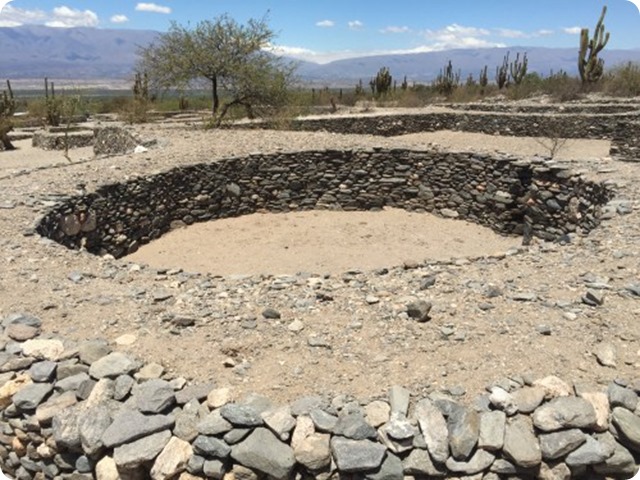
The ruins of Quilmes can be reached from Cafayate (Salta) or from Tafi del Valle (Tucumán).

This location is just stunning, unique and majestic.

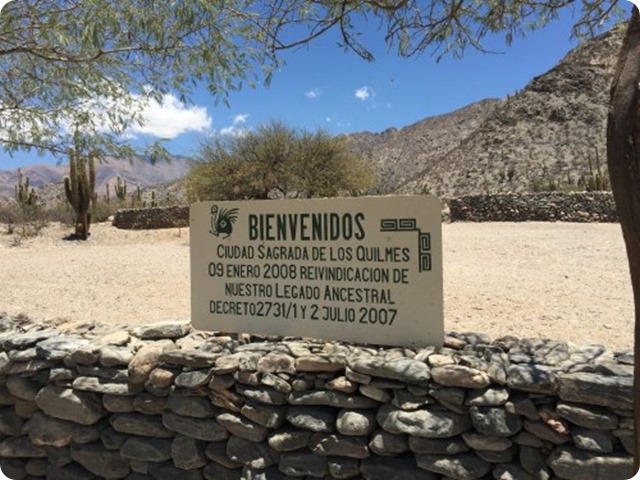
The ruins of Quilmes, as they are known, belonged to the Calchaquí natives who settled on the hillsides and on the mountain range called Calchaquí, from which the tribes got their name: Quilmes and Calchaquí.
Ruinas_Quilmes1

The Ruins of Quilmes are a true cultural heritage of indigenous culture.

About 5,000 people resided the area starting about 850 AD.  For almost 100 years prior to the arrival on the Spaniards, about 1530, the Quilmes fiercely fought the Incas who came south from Peru. 

Location.

quilmes-ruinas
The ruins are located at an altitude of about 2,000 meters (6,500 + feet) elevation. 


The ruins were rediscovered about 1890.  Work was started to restore the ruins in 1978.

My tour guide told me that only about 10 % of the ruins have been restored. 
Read also: Colony of Magellanic Penguins in Peninsula Valdes.
Satellite pictures of both the general area of the ruins and the restored areas are shown below.

Restored area of Ruinas de los Quilmes.

Only about 10% of the ruins have been restored.  This view is courtesy of Bing Maps.
quilmes-ruinas.-original-area


quilmes-ruinas.-restored-area

Conclusion.

I did not know anything about the Quilmes prior to my visit to San Miguel de Tucuman.  I think this was the most interesting part of the visit.  RIQ is just not on the same scale of Machu Picchu (home of the ruler of the Incas). 
The Ruins of Quilmes are a true cultural heritage of indigenous culture.Click to Tweet


What I did learn today was a better appreciation of how large the Inca Kingdom really was, the will the the Quilmes to maintain their freedom from both the Incas and Spaniards, and how in the end they were hauled away as slaves.  It is a great story of the struggles of one of the many indian tribes in South American to maintain their independence for over 800 years.
Images Gallery.
ruinas_Viviendas_QuilmesRuinasdeQuilmes
quilmes-ruinas-1quilmes-ruinas-cactusquilmes-ruinas-cartelquilmes-ruinas-rooms
If you liked this article, subscribe to the feed by clicking the image below to keep informed about new contents of the blog:
rss-icon-feed1
 
Copyright © 2015 Argentina Photo Gallery
Distributed By Gooyaabi Templates
-->