F
For the original peoples, rock art was a tool for communication, a way to transfer ideas, experiences and convictions, a way to reaffirm their own and to participate in other groups of that message put in the immensity of the landscape with the intention aware, that they will last in physical space and time.

In turn, it was a way of intervening territorially, especially when we understand the nomadic condition of its producers, making reference to its inter-related actions related to space: in territorial exploration, in the search for material resources and in ritualization in The geographical spaces.

Therefore, the human figure in rock art cannot be interpreted as an illustrative representation, it is much more than that. The worldview of the South American native peoples includes animated beings and inanimate elements, all of them forming part of an integrated whole that carries the character of sacred.

The human being was understood within that whole.

The representation of human figures in the rock art of the Cuyo region.


The human being was understood within that whole. That sacredness was rooted in the naturalistic and mystical thinking of the people that also hierarchized and deeply respected the characters of power within the community.

This hierarchy is evident in all rock art. Thus, certain human figures have the schematic simplicity and smaller sizes compared to those that show the attributes of power, differing both in the set.
Read also: The lonely Pucará de Hualco, a city of stone, more than a thousand years old.
But whatever its appearance, the human figure, in rock art, is always based on an idea conceived by the naturalistic thinking of the original peoples who considered those of their kind a part in nature and not the axis of the system; which is the most widespread conception in our western and contemporary thinking.

Cuyana region.


In Mendoza, they are chronologically attributed to the period between 400 and 600 years and are culturally associated with the Ovalle style of the Valley of Enchantment in Chile and the culture of El Molle (300 BC-700 AD). This, at later times, would be associated with the Aguada income and would result from an incorporation given by farming groups in the area, which allows us to propose a temporary projection until 900.


The rock manifestations have received different interpretations, predominantly those that emphasize the role associated with shamanic practices. In Mendoza, within the anthropic manifestations, those that refer to heads and mascariforms stand out, which by stylistic association allowed them to be linked culturally and chronologically, but that at the interpretative level led to postulate the representation of experiential experiences of ceremonies where the human head stood out as the center of power and possessor of special forces.

These images would be enhanced as a result of experiences derived from the use of hallucinogenic substances, which, by altering the senses, would favor images in a trance state.
Human figure: hierarchical attributes.

Representation of the human figure.


The human figure is more frequent in the north of the region. In almost all cases they are recorded although we also see it painted, as in the peach eaves in San Rafael.

The representation of some parts of the body is very frequent. In Malargüe the body appears but without head or heads without the body and also the imprint of the human foot.

Other figures move away from a realism and become a different scheme in which the human figure is transformed into a symbolic element, for example the drawing of the head with upper and lower limbs - without the torso - with appendages that start from the same in radial form or with ornamentations in the superior part, as it is the case of the paintings of Los Morrillos and in the Colorados of San Juan and Tundunqueral, in the north of Mendoza.

With variants, the head alone is presented with cephalic attributes or the head with ornamentations and the lower limbs (Tundunqueral, Mendoza and Los Colorados, San Juan). These designs were linked to the tiaras or mascariform heads of the Northern Chilean Boy.

Frequently the characters in rock art are accompanied by birds, felines, snakes and other animals that occupy primary places in the graphic set makes us think that they played an important role in their lives and were part of their rituals. The characters are also seen carrying camelids on a rope, or their stumps or pregnant females, which shows their status as hunter gatherers and the preponderance of these animals in obtaining resources.

The rock, in many cases, is part of the composition and the landscape participates as the setting for the unifying mother earth of "everything." This can be seen in some creations in which engraving and support make up the design, as is the case of the mascariform figure of Painted Stones in San Juan in which the oval shape of rock constitutes the contour of the mascariform.

The Salto Encantado is one of the main natural attractions of the municipality of Aristóbulo del Valle, Cainguas Department, it is part of several jumps included in the Saltos y Cascadas Region.

The Salto Encantado, located about five kilometers from Villa Salto Encantado, between the cities of Aristóbulo del Valle and Dos de Mayo, on National Route 14.

Salto Encantado is part of one of the most interesting alternatives to visit, located in the center of the Province of Misiones, within a Provincial Park of 706 hectares crossed by the Cuñà Pirú Stream.

Hiking trails and baths in a natural pool upstream of the Caña Pirú stream, are among the main activities in the jump.

The Salto Encantado is part of one of the most interesting alternatives to visit in the province of Misiones.

The Enchanted Jump is one of the most impressive falls in the province of Misiones.


The Park's new infrastructure, partially enabled, has been built by revaluing the landscape, using renewable materials and environmentally friendly technologies.

The jump is located within the Provincial Park Salto Encantado, within the department of Caiguás, 126 km from the city of Posadas and 240 from the Iguazu Falls.

Fauna and Flora.


The Provincial Park has an area of ​​706 ha. and it is covered by native forests of great diversity of flora and fauna.

The Caña Pirú stream forms the jump, falling from a height of approximately 60 meters. Walk the park from side to side in the middle of rock formations and walls, creating a landscape of unique beauty. The steam emanated from the waterfall and the cliffs create an environment conducive to the presence of the swift necklace, a bird similar to the swallow and of rare distribution.

The jump has a height of 60 meters and can be seen from its upper circuit and for the more adventurous from its lower base down steep stairs, in the middle of the rock formations and walls. It is common to see birds of different species in the environment, highlighting the benzene.

The park has an interpretation trail that leads to other very attractive minor jumps such as La Olla, Picaflor and Escondido Falls. In this crossing you can see trees that belong to the different native species of the Paraná jungle, such as the black parrot, white parrot, guatambú, cedar, cañafistola among others.

In the middle of an intense green space, covered with jungle, is the great waterfall, the main attraction of the Park, first seen in June 1936.

Tourism.


The Park is prepared to receive tourists with necessary infrastructure for a stay of more than one day, natural pool on the same Cuñá Pirú Stream, restaurant, ample camping space, quinchos, grills, toilets, etc.

The Park is controlled by the park rangers under the Ministry of Ecology, the entrance fee is in charge of the Municipality of Aristóbulo del Valle and the Subsecretariat of Strategic Management takes care of the organization for the attention to visitors.

A group of informants is responsible for indicating to tourists the places to go, the various places enabled and the catarteristics and attractions of the Park. Everyone is recommended to take care of the Park, wear comfortable shoes, provide water, special care for children on the trails and viewpoints, do not disturb animals, etc.

salto encantado 2

Salto Encantado by Rulo Bregagnolo

misiones salto encantado

misiones salto encantado1

misiones salto encantado2

mapa-salto-encantado

Throughout the year the Tourism Entity of Buenos Aires offers free guided tours.

Each month a different theme is presented that follows the attractions of the city, such as tango, theaters, architecture, art and history among others.
El Federal is the oldest operating bar and restaurant in the City of Buenos Aires.


How to tour Buenos Aires through free guided tours offered by the Tourism Entity.


Visits are made on foot and suspended by rain.

Retreat, a corner for art.

The Isaac Fernández Blanco Museum of Hispano-American Art houses a cradle of choice based on artistic and decorative objects from South America from the period of colonial rule to the independent era.

Large palaces and residences that coexist with art galleries and private collections, visiting the Museum of Hispanic Art "Isaac Fernández Blanco".

The Isaac Fernández Blanco Hispanic American Museum is located in the City of Buenos Aires, based in the former Noel Palace (Suipacha 1422) in the Retiro neighborhood. Its collection is based on artistic and decorative objects from South America from the period of colonial domination to the independent era.

Read also: Buenos Aires, the eternal city of Jorge Luis Borges.

The museum began its activity during the 1910s, in the mansion where Isaac Fernández Blanco lived with his family. It was the first private museum in Argentina, with a heritage formed by the private collection that Fernández Blanco had formed for several decades.

The heritage began to expand with donations from several families of the Buenos Aires aristocracy who wanted to place their family objects of great value in a prestigious place.

When the Plaza Lavalle shelled in tangos.

Plaza Lavalle is a green space three blocks from Buenos Aires, Argentina. It is located in the San Nicolás neighborhood, surrounded by Libertad, Lavalle, Talcahuano and Córdoba avenues.


Corners where the tango lived its time of glory, the memory of musicians, poets and singers.
Lavalle Square is a green space three blocks from the City of Buenos Aires, Argentina.

It is located in the San Nicolás neighborhood, surrounded by Libertad, Lavalle, Talcahuano and Córdoba Avenue.
In the vicinity of the Lavalle Square are some of the historical, institutional and cultural sites of the City.

Part of this square was located in the so-called hollow of Zamudio, a vacant lot where in the 18th century there was a lagoon. One of the streams that used to cross the city, the Third of the Middle, ran along Liberty Street and turned east on Viamonte; To cross it, a bridge known as Bridge of Sighs had been built.

By 1822 an artillery park was installed, which owned a weapons factory and a powder depot, taking the name of Plaza del Parque.

Design, sculptures and museums.

The Museum of Contemporary Art of Buenos Aires is a private establishment promoted by the contemporary art collector Aldo Rubino with the objective of acquiring, conserving, investigating, documenting, communicating and exhibiting national and international contemporary art.


A residential area, that mixes french style architecture and Contemporary Art.

Novel lives.


The Museo de la Mujer Argentina was declared of cultural interest and within its purposes it seeks to be an archive and keep the cultural history of women, through the promotion and production of art.

A theater street; a corner of the film, visiting the Women's Museum whose objective is to participate, constitute and carry out:
  • Historical study and research actions that collaborate with the search for specific museological material;
  • exhibitions and displays, archives and libraries, courses, seminars, conferences, colloquiums, and other operational forms;
  • edit brochures and all kinds of publications;
  • sample exchanges and research with other similar institutions in the country or abroad;
  • organize, direct and manage instances of study and creation, and improvement of artistic and cultural disciplines.

Of skies, stars and secrets.

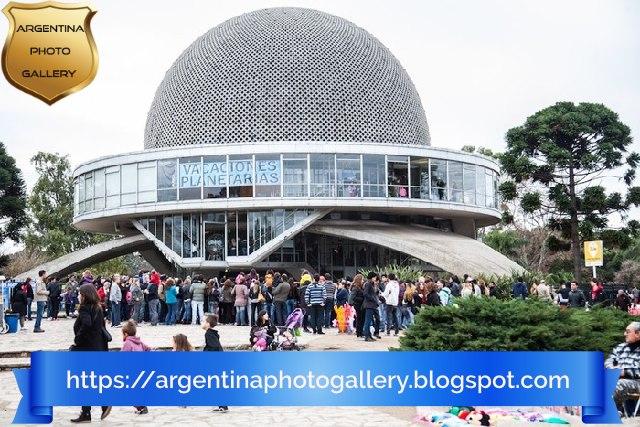
The Galileo Galilei Planetarium was built with the aim of promulgating the dissemination of astronomical science through educational shows for the general public and students.

Discovering art in the dimension of space. Visiting the Planetarium Museum of the City of Buenos Aires "Galileo Galilei".

The Galileo Galilei Planetarium is located at the intersection of Avenida General Sarmiento and Belisario Roldán, within the Tres de Febrero Park, in the Palermo neighborhood, in the city of Buenos Aires, Argentina.

Its dome is 20 m in diameter. On it, 8900 fixed stars, constellations and nebulas can reproduce.
Its first function was carried out in June 1967 and in 2011 it underwent a series of major reforms.
Functions for the blind and the deaf.

The functions for the blind began in June 2001 and are unpublished in Latin America. It is estimated that until 2011, more than 2,500 blind people have enjoyed this experience. With the collaboration of the Argentine Library for the Blind (BAC), tactile celestial maps, relief graphics, a recorded story, music and sound effects are combined.

A large section of the Performance Hall has a magnetic ring to amplify the sound and facilitates the hearing (through the use of hearing aids) of the hearing impaired.

Both types of functions are free and free.

Corner bars, bohemian and evocations.

El Federal is the oldest operating bar and restaurant in the City of Buenos Aires.

A tour of the historic corners of San Telmo, with its past of tango and payadores and its current history preserved.

Located in a traditional corner of San Telmo, this bar that opened its doors in 1864 is worthy of being among the “Notable Bars” since, as if it were a time warp, when visiting it one automatically feels at that time. What hits the most when entering is the bar, crowned by a wooden arch with vitraux details and an inactive clock in the middle.

It retains the original tiles in its floors, and is adorned with elements that emphasize, like few, the true Buenos Aires spirit: the fillets, the old tables, the wooden shelf with its collection of bottles, the cash register of yesteryear, and many others signs that transport us to the past.

Not only the place is traditional; The menu matches the modality perfectly: a Fernet, a Gancia or a craft beer; a sandwich, a tenderloin or a snack, these things well "from here", can be enjoyed at reasonable prices while resting or leafing through a book in the small library.
 
Copyright © 2015 Argentina Photo Gallery
Distributed By Gooyaabi Templates
-->