F
Showing posts with label Neuquén. Show all posts

We were barely a week into our road trip through southern Argentina but it felt like we had been together a lot longer. When we started it, we were 14 strangers but after a few days, we were all friends. The good mood you get from being on the road is contagious, so it was impossible to have a bad time in that context. Every time we had to move from place to place, it was all a commotion, because of the fact that we were going to discover what we could do in the new city. Our third stop was scheduled in Villa La Angostura, one of the most beautiful cities in the province of Neuquén, and as expected, we also had some beautiful days getting to know the surroundings ❤️.


Worldmappin (1).png


That time, our motorhome had to park in front of a square, only two blocks away from the main avenue. This location was very convenient because we were close to the center and to a gas station, which was what we were always looking for to use the public showers and restrooms. The city of Villa La Angostura has a very beautiful aesthetic of wooden buildings and everything decorated with roses that in its peak season, fill the landscape with colors. If I would have to highlight something negative is that most things are expensive in this area because of how touristy it is, but even so it does not stop being crowded all the time


IMG_20240720_124503401~2.jpgIMG_20240720_125106634~2.jpgIMG_20240720_123451688~2.jpgIMG_20240720_124150125~2.jpgIMG_20240720_123037337~2.jpg


After a week of travel, we needed to get a laundry room to get our clothes back in condition. We took advantage of the morning to go in search of one, and on our way back we used our free time to go for a short walk. In Villa La Angostura there are many things to do and several of them are close by, so if you like to be on foot you can visit a few of them. There are also different trekkings available, as well as public transportation to move around, so it's impossible to get bored here .


IMG_20240720_145644378.jpgIMG_20240720_170648403~2.jpgIMG_20240720_152131436~2.jpg


On our morning walk we decided to go to the area of the bays, 2 km away from where our motorhome was parked. This is one of the most touristy and beautiful areas close to the center, so there are always a lot of people coming and going. This place has the particularity of being a small strait between two beautiful bays, so there are two different beaches to spend the day, separated only by about 100 meters. In the area you can also find the entrance to Los Arrayanes National Park, as well as restaurants, public restrooms, kayak rentals and nautical tour services ❣️.


image.pngIMG_20240720_153012092~2.jpgIMG_20240720_152626273~2.jpg


Regarding the bays, the traditional tour is to visit both bays and if it is within your means, to sail in one of them. In July 2024 the nautical tours cost 40,000 ARS ($30 approx), so we decided to visit them on foot. These two bays are called Bahia Mansa and Bahia Brava, very peculiar names as they are two opposite adjectives (Mansa refers to calm and Brava to rowdy). The first one we visited is Bahia Mansa, which offers a long pier to go for a walk and sit and contemplate the scenery ❤️.


IMG_20240720_153045167~2.jpgIMG_20240720_153229740~2.jpgIMG_20240720_153215899.jpgIMG_20240720_153206751~2.jpg


That bay is my favorite, so we spent more time there. Then, we took a look at Brava Bay: just by crossing the street, you could already be on the neighboring beach. There are also boat trips from here, although the pier is not open to the public like the one at Bahía Mansa. However, sitting on the shore to spend the day in this beautiful landscape is also a good plan. What I like about this beach is that the water is crystal clear along much of the shore and gradually turns into a deep blue color ✨.


IMG_20240720_161747782~2.jpgIMG_20240720_161835804~2.jpg


By the time we finished our walk at the end of the day, it was time to pick up our clean clothes. Visiting the area of the bays in Villa La Angostura is a good option for a close walk to get a glimpse of all the beautiful things the village has to offer. This is just a little bit of the incredible scenery that southern Argentina has to offer, so whenever I have the opportunity to return, I fly. You could never get tired of seeing landscapes as perfect as these ❤️.


IMG_20240720_171150699~2.jpg


source

Neuquén Seven Lakes

We did this trip in the fall of last year after going to Bariloche, in Río Negro. To get there we did the so-called "Road of the Seven Lakes", on Route 40. This route crosses almost all of Argentina (before this trip I had no idea about this). If you want to see more images of Route 40 and its landscapes, you can visit @patagonian-nomad's in HIVE blog, who made a great trip traveling it . 

Neuquén the capital of southern Argentina.

On this journey I saw the most beautiful landscapes I have ever seen. I just couldn't believe that those places were real and right before my eyes.

Lake Espejo neuquen 4.jpg neuquen 5.jpg neuquen 6.jpg

San Martin de los Andes.

San Martín de los Andes is a city that is located on the shores of Lake Nacar. It is a very quiet place, or so it seemed to us when we went. 

Everything was beautiful, but we were surprised by the respect for pedestrians they have. 

We actually put one foot on the street and the vehicles would stop and let you cross. Something never seen before in Buenos Aires .

neuquen 7.jpg neuquen 8.jpg neuquen 9.jpg

La Islita, a small island with a unique history. 

Then we went to "La Islita". It was literally a little island. I have a very funny anecdote. 

Not wanting to ask anyone how to get there, we looked for the way on Google Maps and it threw us a route that said it lasted two hours on foot

As we were in good physical condition, we said "okay, two hours walking will not be a problem for us." 

So we set off and actually walked two hours there. We had a lot of fun on the way because we went through forests and laughed at the experience. 

When we finally got to "La Islita", we saw that there was a shorter way to get to the center of the city and it literally took 15 minutes to get back because it was much more direct. 

It was obviously a shortcut that didn't appear on the map. 

We couldn't believe it. Anyway, we had the anecdote to tell our friends . 

neuquen 10.jpg

A beautiful place also in autumn. 

This place was really beautiful. 

As we went in Autumn there was no snow, but I would like to return to see what the city is like when it is covered in white.

neuquen 12.jpg

Source

1.- Cycling the Abra del Acay.

Cycling the Abra del Acay.

Weds 14 Nov: San Antonio de los Cobres – La Poma (c. 2830m) (92km, 1350m ascent). The big day. We set off early, retracing to Los Patos and turning right. The route follows a stream through a broad valley, with a few settlements off the road. At 18km is what looks to be a good campsite (presumably the one used by Stefan Roman). 7km later there is a sandy stretch with no habitation beyond.

Read More ... »

Route 40 extends over 5000 kilometers in Argentina and unites some of the most beautiful and famous country territories. The trail crosses the Cuyo, North and Patagonia.

It passes through 11 provinces, twenty National Parks and Reserves, 13 large lakes and salt mines, and five areas declared Natural Heritage Site.

Kilometer 0 of Route 40 is the Cabo Virgenes in Santa Cruz, and it reaches its end point in the city of Jujuy Quiaca, on the border with Bolivia.

Similar feature to Route 66 in the United States, this Argentine circuit was created in 1935 and although it was not yet fully paved allows full travel with certain precautions.

Infografía-Ruta-40-Patagonia

1.- Hiking trails in Argentina.

Hiking trails in Argentina.

High difficulty circuits which have very hilly with very steep and sustained increases are considered very dangerous descents, tight times for tours on the schedule indicated, orientation problems and poor cyclability. Argentina offers different type circuits for mountain bike enthusiasts: Road of the Seven Lakes: The most chosen by thousands of tourists option is this way, half gravel

Read More ... »

The 5 best places for rafting in Argentina are: Oath Canyon River in Salta; Atuel River Canyon, just outside of San Rafael, Mendoza, the Aluminé River in Neuquén, Río Manso Bariloche and the Corcovado River in Chubut.

Rafting is a team sport where all the crew of the boat row and position your weight in a coordinated way along the river rapids and stay afloat.

rafting 2000x1335

The province of Neuquén has more than 30 lakes surrounded by peaks of eternal white peaks and beech forests, coihues, myrtles and pehuenes.

The setting is ideal for adventure activities like horseback riding, trekking, kayaking outings, photographic safaris, mountain biking and fly fishing.

Today we tell you the main sights of this circuit:

One of the most important lakes in the area is the Aluminé , near which inhabit different Mapuche communities. With an area of ​​over 5,300 hectares occupies a valley that is oriented to the foot of the volcano Bats Mahuida and belongs to the basin of the Black River.
aluminè
The Upper Black River Valley and Neuquén is the area where there is a large number of growers, packers and exporters, ie apples, pears and other fruits such as fine wines.
The climate, rich soil and the tenacity of the old people in the Valley have become the source of excellent fruits, export quality.
With the construction of Ballester Dam and irrigation canals from 1880 about the Valley has established itself as the leading producer and exporter of fruit nuggets country.
manzana

Itineraries: The main attraction of the park are its hot springs. In Copahue are domesticated, they put at the service of health. But in Las Maquinitas, the Amphitheatre and the volcano crater, destination rides and guided walks, wild look in all its splendor. Also reach the border pillar Step Copahue 2013 mts., Where the Mapuche Chilean valley Trapa Trapa arrive daily to sell their crafts.
copahue1
In Caviahue at the foot of the volcano, the offer is no less seductive. A climb of little difficulty, basalt steps, lets visit the seven waterfalls that mark the upper stretch of the river Agrio. Other crossings lead to Cascada Escondida, a jump of nearly 10 meters and the Laguna Escondida.

A 16 km from the villa, by provincial routes 26 and 27, the lower reaches of the Agrio rushes into space from a basaltic terrace to form one of the most captivating of our hydrography jumps. During the winter, while Copahue lies under meters of snow, Caviahue becomes a skiers paradise. Few Andean enclaves match fit for skiing and on the slopes of the volcano, its pistes evolve every year. In March Caviahue held in the "Loom Festival" and the "Feast Pinion".

Waterfall Agrio: The Agrio river which rises in the Copahue volcano, steep drops basaltic terraces and form scenic waterfalls amidst a forest pehuenes.

Laguna Escondida, Copahue Provincial Park, Neuquen
Laguna Escondida, Copahue Provincial Park

Salto del Agrio: 6km. Northwest of Caviahue, the gateway to the Valley trolote, and crossing the bridge over the river is the most impressive jump in the region, with a fall of 45m. and a large ravine, stained ocher and rust.

Cascada Escondida: It comes after a tour on foot at about 3,800 meters. to a jump of about 15 meters. high where a spectacular micro climate, where beautiful flowers or chilco quiver, which can only be appreciated in this place grow is generated.

Laguna Escondida: If we look, hides in the top of the hill behind the village of Caviahue, with different points of ascension, of varying difficulty, according to the level you decide to climb it and we planned a beautiful view of the entire villa Desk.

Sunset in Laguna Escondida
Sunset lagoon La Escondida

South of Caviahue: Laguna Hualcupén, Grab los Barros, The Dairy, which is accessed by car and can make an interesting cultural exchange with the Mapuche community Millaín Currical.

Cliffs Pinto: Walking the boy drawer and drawer Hualcupén at 32km. Caviahue, is the establishment Crags Pinto, with access to the east, is the bizarre rock formation cliffs of Pinto, originating from the reservoir during volcanic eruptions ejected material, and then soldiers naturally by the very high temperature. These striking rocks called ignibritas form a unique landscape.

Lagunas The Triplets: United by a rushing stream, the two beautiful lakes that are the providers of water and reflect the Copahue Caviahue volcano in its waters. These drain by the white stream forms a waterfall under the bridge of the Provincial Route 26.

Seven Falls Provincial Park Copahue, Neuquen
Seven Falls

Machines: With the characteristic noise that gave name to the place, which originated in fumaroles and vents, hot springs emerge from small ponds and green sulfur within the hoyada 1930 where the first domed thermal bath habilito region. Here then I run the first military thermal clinic.

The Maquinitas: Less than 1km. Copahue access, you reach the site of the gadgets. Sulfurous fumaroles, vents and olletas mud and hot springs make a strange landscape between ice tongues, colorful rocks and the constant noise of boiling. There is a wooden walkway that runs the place with basic facilities for thermal baths.

Pozon River in the hamlet Machines, Caviahue, Neuquén
Pozon River in the hamlet Machines

Or Old Volcano Amphitheatre: From Copahue and ascending to the west, for the first spur a first stop to appreciate the sculpture of the Virgen de las Nieves and put us in a strategic point from which we can see on the left the Copahue volcano, the right path up to the balcony of Trapa Trapa through the old volcano or amphitheater in the center and the path leading to the landmark Copahue - Trapa Trapa (dividing point between Argentina and Chile).

Step Hito Copahue. The hike to the border landmark at the foot of the volcano, just over 2.000mts allows the spectacular view of the twin lakes of the Chilean valley and Trapa Trapa.

Spot The Maquinitas, Copahue Provincial Park, Nequén
Spot The Maquinitas
Sulphurous Lake, Copahue Provincial Park, Neuquén
Laguna Sulfurosa

Activities in the Area:
Copahue Acenso the Volcano: One of the few active volcanoes of Argentina with 2.953mts. It has a crater about 200 meters away. below the summit, within this lagoon temperature and variable levels, with a crown of easy shelling rocks and glacier. This is a trip of seven hours. duration that demands not only physical fitness of stakeholders, but also good weather condition.

Adventure: For the adventurous, climbing the walls of basaltic rocks, riding the volcano crater, trekking, windsurfing, bicycles, desensos in inflatable boats, kayak and canoe trips in 4x4 as well.

Arroyo Blanco, Copahue Provincial Park, Neuquén
Arroyo Blanco

Spa, beauty and relaxation: After an active day is nothing better than the incomparable baths Copahue. The combination of mud, mineral water, steam, thermal algae, which are applied to musculoskeletal, dermatological, accompanied by an excellent staff of professionals to help you re-energize. Antistress techniques, curing diseases by natural means and beauty programs complement this excellent proposal for health and relax, do internationally recognized.

Angling: Crystalline streams, ponds and rivers mountain villages of rainbow trout and brook trout, make the place suitable for sport fishing. Trolope Valley offers several ponds and suitable for sport fishing, with frequent sprints and catches averaging 800grms river. In this valley the preserve Trolope Country is located, in view of snowy peaks, wooded hillsides, rushing waterfalls. At this fishery are regional favorites and only fly fishing is authorized. Besides the waters of lakes and stream Hualcupén Hualcupén or lagoon Cacique, places domain Millaín Currical Mapuche community in which you have to request permission to do so, are checked and good places to fish with Fly mode -Casting. Further afield, the rivers Agrio and Trocomán (only waters down Loncopué) and its tributaries are also areas frequented by fishermen.

City Caviahue, Neuquén
City Caviahue, Neuquén. Photo: Natalia Fernandez, CCAM

In winter:
Reds and oranges of ñires, beech stained white with the first snow in April. A short distance from the ski slopes when Copahue is uninhabited and almost buried by snow is accessed through snowtrack and intone Caviahue also covered in a thick white blanket of snow powder makes Ski Resort, one of the most coveted for its long season where the skiing offers insights into the forests of monkey puzzle.

You can make the ascent to the volcano in snowmobiles, motorcycles, snowtrack, and for experienced skiers skiing.

Vista del Lago Caviahue from the ski slopes, Neuquén. Photo: Natalia Fernandez, CCAM
Vista del Lago Caviahue from the ski slopes. Photo: Natalia Fernandez, CCAM

For lovers of wind, snow kiting is an alternative to enjoy the place. In August, the long weekend, the party "Avalanche Night Party", the meeting of "Polo in the snow" and "Fashion Show" among other events takes place.

Adventure and fun: walking snowmobile or sled huskies funny, snowshoeing, cross-country skiing are some of the means for the family to enjoy the adventure. Frozen waterfalls, lagoons hot vapors emerging braving the cold of winter. Trips snowtrack towards Copahue.

Skiing: From June to September, in the integrated Caviahue offers excellent mountain slopes with abundant powder snow center for experts and beginners, complete this offer.

Caviahue Ski Center, Neuquén. Photo: William Martin
Caviahue Ski Center. Photo: William Martin
Caviahue Ski Center, Neuquén
Caviahue Ski Center. Photo: Natalia Fernandez, CCAM


Andino Club Caviahue
The ñires s / n Camping Kaime
Phone: 02948.495216
clubandinocaviahue.cac @ gmail.com
clubandinocaviahue.blogspot.com
Municipality and Tourism Caviahue-Copahue
Street April 8 s / n, Cabins 5 and 6 - Caviahue, Neuquén.
Phone: 02948.495036 / 144
volcancop7@yahoo.com.ar
consultas@caviahue-copahue.gov.ar.
turismocaviahue@hotmail.com
www.caviahue-copahue.gov.ar
Refuge Poodle
Cel: 0299.154.211085 - 0353.155.083898
elrefugiodecaniche@hotmail.com
Facebook: The Refuge Poodle (Hotel)

If you liked this article, subscribe to the feed by clicking the image below to keep informed about new contents of the blog:

Exceptional features, it is one of the country's thermal havens

Copahue Provincial Park, located northwest of the province of Neuquén, Patagonia Argentina, meets two criteria proposed for the assessment of outstanding universal value and to be declared a World Natural Heritage by the United Nations Organization. On the one hand, represent natural phenomena or areas of exceptional natural beauty and aesthetic importance as forests puzzle trees and thermal manifestations and, moreover, is a representative example of the major stages of earth's history.

This is stated in the petition that made the Neuquén provincial government, through the Secretariat for Planning and Action for Development-COPADE that Argentina requested the National Commission for Unesco in order to include in the indicative list Copahue of Argentina to be declared a World Natural Heritage by the United Nations Organization for Education, Science and Culture.

copahue

The Copahue Provincial Park, about 28,300 hectares, was created to protect the thermal resources and ancient forest of puzzle trees. Among the most prominent natural attractions to the naked eye is the volcano that bears the same name, as well as a large field that surrounds the lake Caviahue changing product glaciations.

The area has unique characteristics and peculiarities in various aspects that stand out internationally. The volcanic past of the area led to fumaroles and hot springs that mineralize and endow temperature meltwater, forming different thermal resources for quality, diversity and simultaneity are hard to find elsewhere on the planet. The thermal complex is internationally known for the quality and therapeutic properties of its waters, algae and mud, providing the protected area of ​​particular relevance for the scientific, tourist and interpretive view.

Many years ago, this area started to become one of the most preferred places for tourists seeking exclusivity, snow, relaxation and adventure in a natural oasis with unique features in the world. Caviahue-Copahue The resort offers the possibility of trekking, mountaineering, winter sports and activities. Also, take hot baths with mud, algae and fumes from the volcano, which are a must given throughout the summer.

The modern thermal center is at Copahue - "sulfur water" in Mapuche language accommodates for 2,500 baths per day, but only open from November to April because of heavy snowfall that usually fall in the area. Meanwhile, during the winter season all visitors staying at Caviahue-distant just 18 kilometers from where they make fun and original excursions like climbing to the crater of the volcano hike or snowshoe with a Mapuche lonco.

The value of Hydrotherapy

There are numerous thermal manifestations of volcanic origin within the Copahue Provincial Park. Fumaroles and hot springs mineralize the soil and sludge meltwater, forming different resources whose qualities are hard to find elsewhere on the planet. The development of the activity dates back to the Aborigines who considered these rich baths for the spirit. Currently in the complexes exist Copahue and Caviahue custom programs that combine different techniques. More information: thermal Argentina, from end to end.

Home Welcome to Copahue Provincial Park, Neuquén. Photo: William Martin
Lake Caviahue. Copahue Provincial Park, Neuquén
Lake Caviahue. Copahue Provincial Park

The Agrio River, which rises in the crater of the volcano and some minor streams by volcanic slopes down to the falls, and make offerings to the landscape falls as seductive as the Basalt Water, Giant, Lady's Hair, Salto Escondido and the imposing Salto del Agrio, with its 35 meters high.

The heritage park complete with remnants of the former masters of the land, archaeological sites scattered through the valleys of streams and Jara Dulce, in the vicinity of Villa Caviahue, where, despite the furtive visit prehistoric souvenir hunters, even can be found pipes, axes, grinding tools and remains of pottery.

Map of the area and Copahue Caviahue

Getting there: The town of Caviahue - Copahue is located in the department of Ñorquín, Neuquén. It lies just 363 km from the capital completely paved provincial and 1500 km approx. City of Buenos Aires. You can arrive at the destination via terrestrial means (private car, bus (company Cono Sur from Neuquén) and direct charter Winter Capital Federal / Caviahue). From Loncopué Caviahue combi or limos services are also offered.
From Chile, the Paso International Hachado Pino is 179 km by passing national paved roads No. 22 and No. 40 and No. 21 provincial and No. 26.
After traveling 18 kilometers, by Provincial Route 26 above Copahue, located NW of Caviahue.

View from Volcano Copahue Caviahue City, Neuquén. Photo: William Martin
View from Volcano Copahue Caviahue city. Photo: William Martin
Laguna Copahue Crater Volcano, Neuquén. before reaching the summit at 2,750 meters high, the volcano has a lagoon of sulfur water, having a temperature baria between 18 º and 32 º degrees
Laguna Copahue Crater Volcano. Before reaching the summit at 2,750 meters high,
The volcano has a lagoon of sulfur water, which has a temperature baria between 18 º and 32 º degrees

From Buenos Aires, through regular flights to Neuquen Capital and continue the journey by buses, vans and cars rented by fully paved roads to Caviahue. (Nac Routes No. 22 and No. 21 and Prov 26).

Caviahue City: It is a young city founded on 8 April 1986, but its history goes back to the 30s when the settlers came to the region Neuquén especially the hot springs by the use of the waters of . The first hotel accommodations were built by private initiative and in the 60s with the construction of a hotel, conducted by the provincial government of the zone is activated again. In 1999, Caviahue - Copahue is declared third class municipality through the provincial Law No. 2273.

Climate: The average annual temperature varies between 3 ° C and 4 ° C. In summer there is a large temperature range. Rainfall exceeds 2000 mm. year, occurring mainly between the months of April and October and fall mostly as snow.

Salto del Agrio, Copahue Provincial Park, Neuquén
Salto del Agrio Provincial Park Copahue

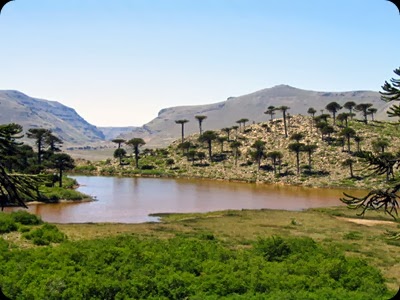
Flora: The importance of Copahue Provincial Park on the northern edge constitute or northern distribution of Araucaria araucana or Pehuén in Argentina (the southern limit is up to San Martin de los Andes south of the Province of Neuquén). The Araucaria araucana, constitutes the natural heritage of the place, as well as being an ancient species, is a symbolic tree in the province of Neuquén Mapuche communities and for being the fruit - the "Sprocket" - their food base .

The steppe is the predominant vegetation type, extending into hillsides, plateaus and valley bottoms below 2,000 meters. Dominate coirones and various species of low shrubs and dwarf with relatively high percentages of bare soil (20 to 60%). Peladares and semi-deserts extend over 2,000 meters. on the high slopes of the western sector and the edges of the saws and Unemployed Trolope Palos.

Up the hill Puntiagudo and Lamas, Copahue Provincial Park

The vegetation cover is low, around 30%, decreasing with increasing altitude, until its demise over 2,400 mts. A considerable amount of mallines height is associated with its water springs above 2,000 mts.

The vegetation is dense adjacent to the drainage network, interspersed with semi-desert and steppe vegetation in areas peripheral zone. Various cushions, mosses, grasses, rushes, sedges and forbs make up these complex herbaceous-shrubby, especially important for its high diversity, high fragility and the role they play in water regulation.
The ñire, develops as a shrub, forming thickets, occupying plateaus, slopes and embankments in various sectors of the area. In many cases there is evidence to indicate that these scrubs are a secondary successional stages after fire in Araucaria forests or lenga. The other Nothofagus present, the lenga forests and low shrublands form of very restricted distribution.

Serge kite, Caviahue, Neuquén
Serge kite, Caviahue
Skiing off-piste in the forest, Caviahue. Photo: William Martin

It can also be observed during the months of November onwards wildflowers as the "Topa Topa 'and' Flower Copahue" mutisias, etc..
Since the prevailing environment of this area are steppe and semidesert tall, environment in which are particularly relevant Araucaria araucana forests or Pehuén, which despite occupying a relatively small area within the area (nearby Caviahue Lake and the White River Valley, about 2.5% of the total area of ​​Copahue Provincial Park) one of the objectives of the creation of the protected area was just protecting this relict species, which grows in Argentina, only in a narrow strip of the Andes, the northern boundary being Copahue growth.

The pine growing on hillsides and rocky outcrops below 1800 meters., Developing underneath them ñires dense undergrowth.
Araucaria Male: You can see the catkins ú reproductive organs.
Small Araucaria: These ancient trees or vegetable dinosaurs have a very slow growth. They grow only 3 to 5 cm. per year.

Fauna: The park has a particular interest in faunal be a transition zone between three major ecological regions: the High Andes, the Patagonian and Subantarctic, with the addition of some elements of the adjacent regions of Chile. Although the area is not known for having large animals still inhabit the very persecuted colored / gray foxes and pumas.

The park is of great relevance to conservation because in this area can be found a number of small species that can only be found in our country, and around this area such as the Tucu tucu Maule, rodent highly specialized to live underground and several species of lizards, also a kind of Infant four eyes, not yet described by scientists. Among the birds you can see condors, eagles blackberry, Patagonian gulls, geese or geese, ibises and others.

View the gaps The Triplets

If you liked this article, subscribe to the feed by clicking the image below to keep informed about new contents of the blog:

 
Copyright © 2015 Argentina Photo Gallery
Distributed By Gooyaabi Templates
-->